Guides

Get the comparison and learn how Cuick Trac compares to other solutions across cost, speed, compliance, and support.

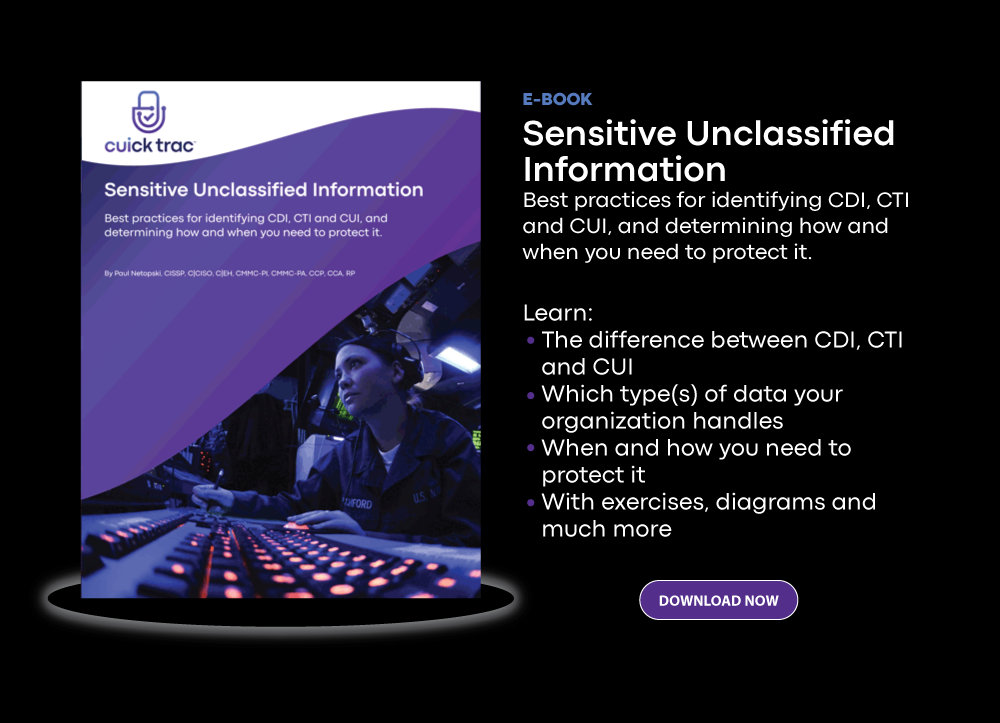
Download our ebook to learn the best practices for identifying CDI, CTI and CUI, and determining how and when you need to protect it.

Take a closer look at how Cuick Trac simplifies CUI security and CMMC compliance—no IT overhaul required.

Learn which CMMC Level 2 requirements organizations still own and how responsibility is typically shared during assessments.

Compliance Guides for
Defense Contractors

Defense contractors face three mandatory cybersecurity frameworks: CMMC Level 2, NIST SP 800-171, and DFARS 252.204-7012. As of November 10, 2025, contractors handling Controlled Unclassified Information (CUI) must complete Level 2 self-assessments or third-party certifications for applicable DoD contracts under DFARS 252.204-7021. Our compliance resources are built to help defense contractors better understand their responsibilities, reduce confusion, and prepare for certification.

CMMC Compliance

CMMC (Cybersecurity Maturity Model Certification) is the DoD’s verification framework for contractor cybersecurity. It defines three certification levels based on information sensitivity and requires contractors to demonstrate compliance through self-assessment or third-party audit.

Getting Started

CMMC Levels Explained Level 1, 2, and 3 overview

CMMC Self-Assessment Guide Step-by-step readiness process

CMMC 2.0 Scenarios & Strategies Compliance approaches for OSCs

Assessment Preparation

Assessment & Certification Process What to expect during audits

CMMC Audit Guide  – Preparing for assessment

SSP & POA&M GuideRequired documentation

Advanced Requirements

Level 3 Controls & RequirementsEnhanced security requirements

DFARS Compliance

DFARS 252.204-7012 is the contract clause that requires defense contractors to implement NIST SP 800-171 security controls and report cyber incidents. Non-compliance can result in contract termination, withheld payments, and exclusion from future awards. 

Understanding Requirements

DFARS Compliance – Complete overview of DFARS 252.204-7012

DFARS 252.204-7012 Compliance, Access Control How DFARS and NIST 800-171 connect

DFARS Compliance Checklist– Step-by-step implementation checklist 

Implementation

DFARS Compliance Services Guide – Advisory, managed services, and enclave options 

DFARS Readiness Assessment – Pre-audit gap analysis  

NIST Compliance

NIST SP 800-171 defines 110 security requirements for protecting Controlled Unclassified Information (CUI) in non-federal systems. These requirements form the technical foundation of CMMC Level 2 certification and DFARS contract compliance. 

Understanding Requirements

NIST Compliance – Overview of the NIST SP 800-171 framework

800-171 Implementation Guide – Control-by-control implementation guidance

NIST 800-171 Compliance Checklist – Gap assessment and readiness checklist

Implementation & Documentation

NIST 800-171 Compliance Solutions – Comparing on-premises, cloud, and enclave approaches

NIST 800-171 Policies, Procedures & Standards – Required compliance documentation and templates

Assessment & Validation

NIST SP 800-171 DoD Assessment Methodology – How the DoD evaluates contractor compliance

Frequently Asked Questions

DFARS 252.204-7012 is the contract clause requiring defense contractors to protect Controlled Unclassified Information (CUI). NIST SP 800-171 defines the 110 security requirements contractors must implement. CMMC is the certification framework that verifies contractors have implemented those requirements through self-assessment (Level 1 and some Level 2) or third-party assessment (Level 2 C3PAO or Level 3 DIBCAC).  In practice: DFARS tells you that you must comply, NIST 800-171 tells you what to implement, and CMMC is how the DoD verifies you’ve done it. 

Timeline depends on your starting point and chosen approach. Traditional on-premises implementations typically take 6-12 months: 2-3 months for gap assessment and scoping, 3-6 months for technical control implementation, 1-2 months for documentation and System Security Plan (SSP) development, plus assessment scheduling and remediation activities.

Cuick Trac’s managed enclave approach helps accelerate compliance readiness by providing pre-configured, continuously maintained technical controls within a dedicated compliance boundary. Contractors can focus on the remaining organizational requirements such as policies, training, and incident response procedures while Cuick Trac manages the underlying technical infrastructure.

Beginning November 10, 2025, CMMC requirements began phasing into applicable DoD contracts involving Federal Contract Information (FCI) or Controlled Unclassified Information (CUI).

Phase 1 (November 2025 – November 2026) requires Level 1 or Level 2 self-assessments for many applicable contracts. Phase 2 (beginning November 2026) introduces mandatory third-party C3PAO assessments for applicable Level 2 contracts, while Phase 3 adds Level 3 DIBCAC assessments for select critical programs.

Contractors must maintain the appropriate CMMC status in the Supplier Performance Risk System (SPRS) to be eligible for applicable contract awards involving the handling of FCI or CUI.

A managed enclave is a secure, isolated cloud environment where all CUI processing, storage, and transmission occurs. Instead of securing your entire corporate network—laptops, servers, email, file shares—you move CUI handling into a controlled environment that’s already configured to meet NIST 800-171 requirements.  Cuick Trac’s managed enclave is built on Microsoft GCC-High and achieved FedRAMP Moderate Equivalency from a FedRAMP-recognized 3PAO. The enclave includes pre-configured access controls, encryption, logging, incident response, and continuous monitoring. Contractors access the enclave via secure virtual desktop, eliminating the need to upgrade corporate IT infrastructure.  This approach reduces your assessment scope from your entire organization to just the enclave boundary plus organizational policies. 

Yes. Cuick Trac is designed to work alongside your current MSP or internal IT team, not replace them. Your existing team continues managing corporate IT (email, productivity tools, internet access). Cuick Trac handles the secure enclave where CUI lives.  Integration typically involves: defining which data qualifies as CUI, establishing workflows for moving data into/out of the enclave, coordinating user provisioning, and documenting the shared responsibility matrix. Most MSPs prefer this approach because it removes the compliance burden from their infrastructure while preserving the customer relationship.

For self-assessments (Level 1 and some Level 2), you identify gaps and document them in your Plan of Action & Milestones (POA&M). You can achieve “Conditional” CMMC status if you score 88 or above and have a POA&M for remaining gaps. You have 180 days to close POA&M items and achieve “Final” status.  For third-party assessments (Level 2 C3PAO or Level 3 DIBCAC), failing means you don’t receive certification. You must remediate deficiencies and schedule a new assessment. This is why readiness assessments before the official C3PAO audit are critical—they identify gaps you can fix before the formal assessment. Organizations may qualify for Conditional CMMC Status if eligible requirements are documented in a POA&M and remediated within the required timeframe.

Level 1: Protects Federal Contract Information (FCI). Requires annual self-assessment against 15 basic safeguarding requirements from FAR 52.204-21. No third-party assessment required. 

Level 2: Protects Controlled Unclassified Information (CUI). Requires implementation of all 110 NIST SP 800-171 Rev 2 security requirements. Assessment method depends on CUI sensitivity: self-assessment for non-DoD CUI, C3PAO third-party assessment for DoD CUI. Certification valid for 3 years with annual affirmations.

Level 3: Protects CUI for critical national security programs. Requires Level 2 plus 24 additional requirements from NIST SP 800-172. Mandatory DIBCAC assessment every 3 years. Reserved for contractors supporting DoD’s most sensitive programs.  Most defense contractors need Level 2. Level 1 applies only to contractors handling FCI but no CUI. Level 3 is specified in contracts for advanced weapons systems, intelligence programs, and critical infrastructure.

Yes. Prime contractors must flow down CMMC requirements to subcontractors at any tier who will process, store, or transmit FCI or CUI. The required CMMC level matches the sensitivity of information the subcontractor handles.  Prime contractors are responsible for verifying subcontractor CMMC status before award and ensuring subcontractors maintain compliance throughout the contract period. This verification occurs through SPRS, where subcontractors must post their assessment results and annual affirmations.  Subcontractors without valid CMMC status cannot be awarded subcontracts involving FCI or CUI, which excludes them from most DoD supply chain opportunities.

Let’s Make Compliance Simple

Part of the Most Relevant
Industry Groups & Committees

e-Book

Sensitive unclassified Information

Best practices for identifying CDI, CTI, and CUI, and determining how and when you need to protect it.

Learn;

  • The difference between CDI, CTI, and CUI
  • Which type(s) of data your organization handles
  • When and how you need to protect it
  • With excercises, diagrams and much more. 

🍪 We Use Cookies

To enhance your experience and analyze site usage, we use cookies. By continuing to use our site, you agree to our use of cookies in accordance with our Privacy Policy.