
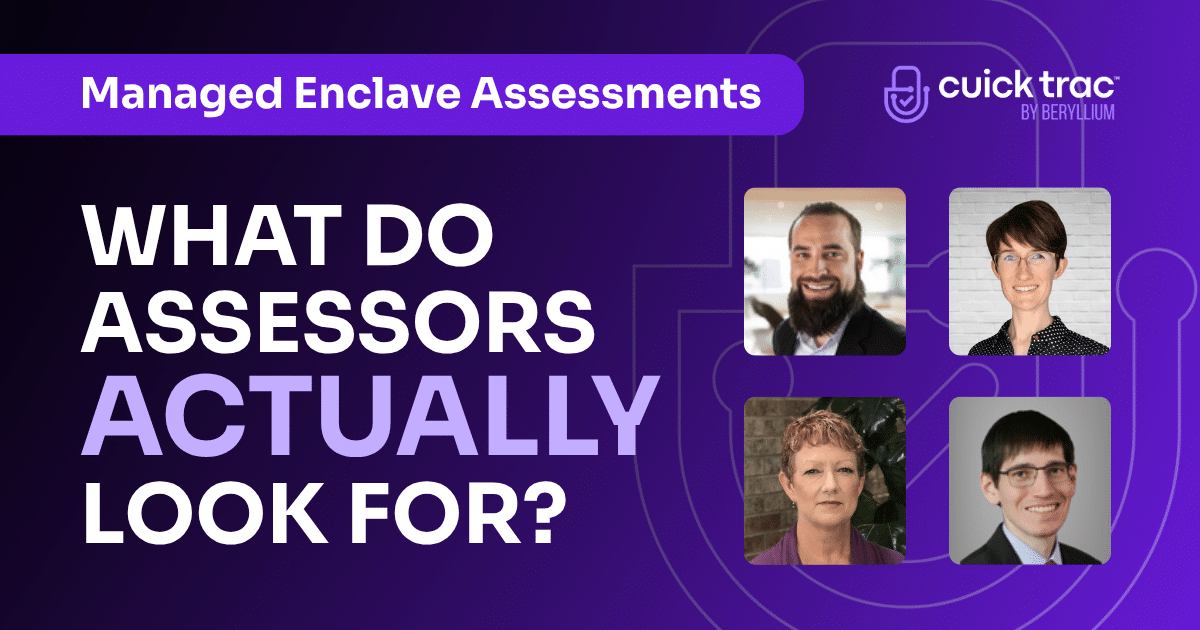
Assessor Roundtable: What Contractors Should Know Before Assessing a Managed Enclave
A managed enclave can shrink the scope of your CMMC assessment, but it doesn’t make the assessment go away. In our recent Assessor Roundtable, four experts who’ve sat on both sides of the table explained what assessors actually check in a managed enclave, and where contractors get tripped up.
Watch the full session below, or read on for the highlights.
The panel
- James Ahern, Federal CTO and Lead Assessor, ControlCase. A Lead Certified CMMC Assessor (LCCA) with experience across the federal, state and private sectors.
- Katie Dodson, President, Defense Solutions, Hive Systems. A Lead CCA who has taken part in more than 50 assessments.
- Glenda R. Snodgrass, Founder, President, Lead Consultant and Project Manager, The Net Effect. A Lead CCA who works on the contractor side, preparing clients and guiding them through assessment.
- Nathan Regola, Ph.D., J.D., President, Regola Cyber. A CCP and CCA with more than 15 years of experience architecting complex cloud systems.
Moderated by Rhett Coleman, Senior Solutions Architect at Cuick Trac.
A managed enclave isn’t set-and-forget
The most common assumption the panel hears is that signing up for an enclave means the work is done. Glenda Snodgrass put it simply: new clients “think they write a check and they’re done.”
The enclave provider may handle most, or even all, of the technical controls. But some responsibilities always stay with you:
- Personnel screening
- Security training
- Written policies and procedures
These are part of the inheritance model, and you have to keep them up throughout the life of your certification, not just before the assessment.
Start with your CUI boundary
“The CUI data flow is the foundation of your compliance program,” Glenda said. Before choosing an enclave, map how CUI moves through your business and confirm all of it can stay inside the enclave.
An enclave works best when your team only needs to view or edit CUI there. Once people need to download files or print locally, things get complicated. Your C3PAO will expect a well-defined boundary that you can justify.
Assessors start in the same place. James Ahern explained that every assessment begins with how you’ve declared your scope, using Table 4 of 32 CFR Part 170. From there, assessors expect a customer responsibility matrix (CRM) showing which controls are fully inherited, partially inherited or entirely yours.
Your enclave also has to match how your business actually works. James described contractors who buy a cloud-only enclave, then win a contract that requires them to handle paper CUI. When that happens, assessors will ask whether your enclave’s authorization still covers what you’re doing.

Verify FedRAMP Moderate equivalency yourself
DFARS requires cloud providers that store, process or transmit CUI to meet FedRAMP Moderate or its equivalent. A provider saying they’re equivalent isn’t enough.
Katie Dodson has been on scoping calls where a contractor’s cloud provider claimed equivalency but never supplied a body of evidence (BOE). In some cases the provider wasn’t equivalent at all. “Now you’ve got a major scope problem,” she said, “because you have a CUI asset that is not compliant.”
The FedRAMP Marketplace has a similar trap. A company’s name being listed doesn’t mean every product it sells is authorized. Only specific cloud service offerings are covered, and some may still be in process.
What to do before your assessment
Glenda gives her clients a checklist built from the DoD’s FedRAMP Moderate equivalency memo. Log into your enclave, find the provider’s BOE and confirm:
- Every required item is present
- Recurring items are current. For example, vulnerability scans must be no more than 30 days old.
- You’ve signed and dated the checklist, so you can hand it to your assessor as evidence
Nathan Regola added a warning: actually read what you’re signing. If you attest that scans are current and they turn out to be three years old, that’s on you.
Inherited, shared or yours: read your CRM
Using a managed enclave doesn’t move every responsibility to your provider. The CRM tells you exactly what does. It’s usually a spreadsheet that marks each of the 320 assessment objectives in NIST SP 800-171 as inherited, shared or customer-owned.
“Literally they tell you everything,” Glenda said. Most confusion about who owns what comes from never reading it. Read it yourself, or hire someone to read it and explain it to you.
How assessors check inheritance
When you say a requirement is inherited, Katie goes straight to the CRM to confirm it’s marked fully inherited. If it says shared or not inherited, expect more questions. For some controls, such as vulnerability remediation or change management, the provider may still need to show that they’re doing the work.
One catch: many cloud providers’ CRMs are mapped to NIST SP 800-53, not 800-171. That means mapping between the two.
“Fully inherited” can still mean documentation
Take password complexity in Microsoft. You can’t change it, because it’s fully inherited. Even so, some C3PAOs expect you to define the requirement, to show you understand what your provider enforces. It’s usually a quick documentation fix, but expectations vary from one C3PAO to the next.
Why it matters legally
Nathan pointed out that you, not your provider, hold the contract with the government. If you misread or skip your shared responsibilities, you aren’t meeting your obligations. That risk grows if you use your provider’s templated system security plan (SSP) instead of building your own.
Choosing the right C3PAO
You choose your C3PAO, the third-party organization that assesses you for CMMC certification. The panel shared what to ask before you commit:
- Who are your lead CCAs? Many C3PAOs share the same part-time lead assessors, and “that individual sets the tone of the entire assessment,” Glenda said. Look them up, and read what they post on LinkedIn and in blogs to get a sense of how they think.
- Have you assessed environments that rely on inheritance? James suggested asking this on the intake form. Experience with your type of provider is a plus.
- Have you assessed FedRAMP Moderate equivalent environments? Katie explained that these need extra checks, such as reviewing the body of evidence and confirming it’s current. An inexperienced team may dig into things that don’t need it.
- How do you handle conflicts of interest and ethics? Nathan said a C3PAO should answer these questions willingly.
James also recommended a readiness assessment, or mock, with your C3PAO, so you know their style before the real thing.
Technical fit matters too, especially if your provider isn’t FedRAMP Moderate equivalent. Nathan put it this way: a Windows assessor reviewing a Linux environment may not give you a thorough assessment. Because you have to attest that your assessment was fair, that’s a risk you don’t want.
Getting ready for assessment day
Have everything ready one to two weeks ahead of time. “If my client is pulling the evidence together the day before the assessment, we have a problem,” Glenda said. Her advice for the day before is to leave work on time, drink lots of water and get a good night’s rest.
Documentation is where assessments stall
“CMMC is very show and tell,” Katie said. Assessors test you against your own SSP, policies, procedures and definitions. If those aren’t complete, they can’t fully assess you. Missing even one objective can cost you certification.
Make sure your documentation:
- Addresses every requirement down to the objective level
- Is final and approved. Assessors can’t accept drafts.
Evidence contractors scramble to find
James named the controls where he most often sees missing evidence, even in well-scoped enclaves:
| Control | What You Need to Show |
|---|---|
| AC 3.1.22 | Content is reviewed before it’s posted to public websites, and reviewed periodically after |
| CM 3.4.3–3.4.5 | Security impact analysis of physical or logical changes to your environment |
| IR 3.6.3 | An annual incident response tabletop exercise |
| RA 3.11.1 | An annual risk assessment |
Holding the meeting isn’t enough. “If the procedure says that you’re going to create an after-action report and you can’t show that you followed the procedure, you’re going to have some painful documentation requests,” James said.
Bring the right people
Assessors want to talk to the people who actually perform each control. If HR handles personnel screening, someone from HR needs to be there. You can’t have one IT person or your MSP answer for everyone, Glenda said.
Whoever answers questions should also know the SSP, especially if it came from a template. Nathan added that the exact wording of NIST SP 800-171 matters. If you believe you meet a requirement, don’t be afraid to argue it, or to appeal to your C3PAO and the Cyber AB.
Is a managed enclave right for you?
“A fully managed enclave is a fantastic solution for many businesses, but not for all businesses,” Glenda said in her closing remarks. Before you commit, make sure your CUI workflow fits inside an enclave, that you understand your responsibilities, and that you’ve vetted your provider’s evidence.
The panel covered much more than we could fit here, including FedRAMP’s staying power and how to find common ground with your assessor. Watch the full Assessor Roundtable to hear it all.
Have questions about managed enclaves or getting ready for your CMMC assessment? 👉 Talk to a Cuick Trac Expert
